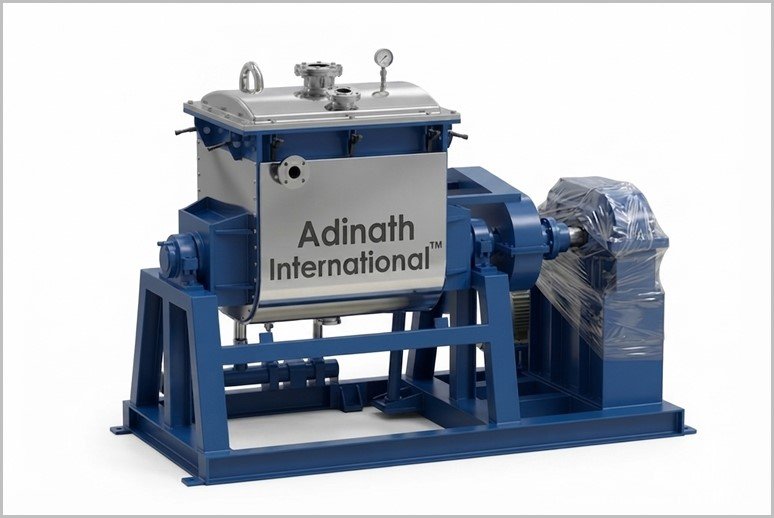
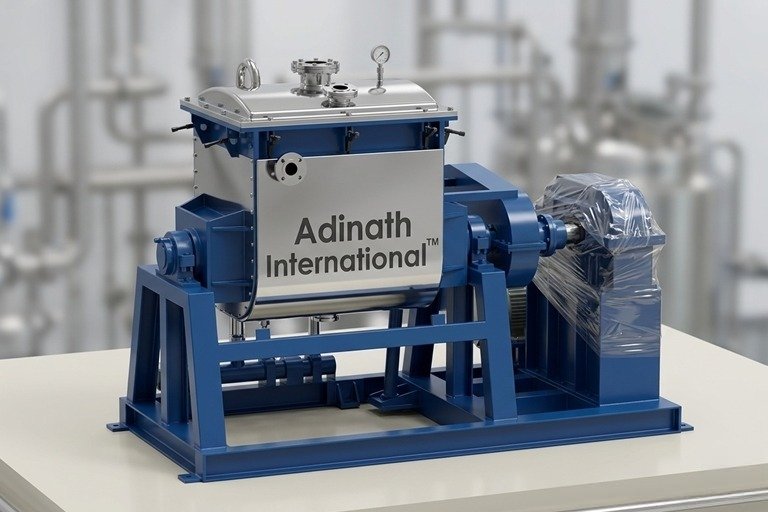
A Stainless Steel 316 Sigma Mixer, also known as a sigma blade mixer, Z-blade kneader, or double-arm kneader, is a heavy-duty industrial mixing machine specifically designed for processing high-viscosity, sticky, dough-like, and paste-like materials. Its premium SS 316 construction makes it the preferred choice for industries requiring superior corrosion resistance, hygiene, and durability.
Stainless Steel 316 offers excellent resistance to corrosion, acids, alkalis, and harsh chemicals compared to regular SS 304. This makes the SS 316 Sigma Blade Mixer ideal for applications involving aggressive ingredients, food products, pharmaceuticals, and specialty chemicals.
Dual counter-rotating ‘Z’-profile (Sigma) paddles spin synchronously at precise differential velocities, generating a tangential wiping action that continuously shifts and transports the batch across the vessel length.
Processed batches can be unloaded through three versatile pathways: tilting the entire mixing trough, releasing bottom-mounted drain valves, or driving the mass out via a parallel side-mounted extrusion screw.
The compounding cycle merges macro-displacement, stretching, folding, splitting, and re-mixing. Simultaneously, intense mechanical shear and tearing forces generated between the rotating elements and interior housing walls effectively reduce solid particle size.
Once the preset batch sterilization duration finishes, the heating circuit automatically cuts off, the pneumatic exhaust flap opens, and the cooling sequence initiates.
In this layout, agitators spin inside the trough while meeting tangentially—typically with the leading paddle operating at a faster 3:2 speed ratio relative to the rear. This high-torque configuration is optimized for dense, heavy media such as rubber polymers, adhesives, pigment pastes, and dyes.
The agitators intersect directly above the central ridge, requiring exact synchronization so both spin at identical speeds. This accelerates cross-transfer between compartments, making it ideal for fluid or creeping substances like cosmetic creams, pharmaceutical ointments, clay coatings, and carbon pastes while exerting lower shear and kneading forces.
Model | Capacity – Liters | Motor (H.P.) | ||
Working Capacity approx. | Gross Capacity approx. | General | Heavy Duty | |
ASM – 50 | 50 Liters | 80 Liters | 5 H.P. | 7.5 H.P. |
ASM – 75 | 75 Liters | 110 Liters | 7.5 H.P. | 10 H.P. |
ASM – 100 | 100 Liters | 150 Liters | 10 H.P. | 15 H.P. |
ASM – 150 | 150 Liters | 200 Liters | 15 H.P. | 20 H.P. |
ASM – 200 | 200 Liters | 300 Liters | 20 H.P. | 25 H.P. |
ASM – 400 | 400 Liters | 550 Liters | 30 H.P. | 40 H.P. |
ASM – 500 | 500 Liters | 750 Liters | 40 H.P. | 50 H.P. |
ASM – 750 | 750 Liters | 1150 Liters | 50 H.P. | 60 H.P. |
ASM – 1000 | 1000 Liters | 1500 Liters | 60 H.P. | 70 H.P. |
ASM – 1500 | 1500 Liters | 2100 Liters | 75 H.P. | 80 H.P. |
ASM – 2000 | 2000 Liters | 2600 Liters | 80 H.P. | 90 H.P. |
ASM – 3000 | 3000 Liters | 3800 Liters | 100 H.P. | 120 H.P. |
* Power voltage can be adjusted as per customer’s domestic power voltage requirements.
* Rights of technical improvements & modification reserved.
* Illustrations & dimensions are shown for information purpose only.
Stainless Steel 316 provides superior resistance to corrosion, acids, alkalis, and harsh chemicals compared to SS 304. This makes it ideal for aggressive ingredients in pharmaceuticals, food products, and specialty chemicals, while also offering better hygiene and durability. Mild steel versions are available with protective coatings but lack the same corrosion resistance.
It is built for high-viscosity, sticky, dough-like, and paste-like materials such as stiff pastes, adhesives, rubber compounds, dyes, pigments, creams, ointments, and similar formulations that standard mixers cannot handle effectively.
The tangential design uses two counter-rotating sigma-shaped (Z-type) blades that meet tangentially, with the front blade typically rotating faster (often in a 3:2 ratio). This creates intensive kneading, folding, shearing, stretching, and recombining actions, ensuring uniform mixing with minimal dead zones, especially for higher-viscosity materials.
Models range from ASM-50 (approx. 50 L working / 80 L gross capacity; 5 HP general or 7.5 HP heavy duty) up to ASM-3000 (approx. 3000 L working / 3800 L gross capacity; 100 HP general or 120 HP heavy duty). Voltage can be customized to local power requirements.
Discharge options include manual hand-wheel operation, hydraulic (automatic) systems, tilting the container, bottom valves, or an extrusion screw system. These ensure efficient removal of ultra-viscous materials with minimal residue.
Yes. A jacket for heating or cooling can be fitted, complete with mineral wool insulation and cladding. Optional blade cooling arrangements are also available to manage temperature-sensitive pastes and adhesives.
PTFE shaft sealing is provided for food-grade compatibility. Stainless steel surfaces can be polished to a matt or mirror finish as required, and the minimum gap between the trough and blades helps prevent product sticking, supporting clean and hygienic operation.
It is widely used in the pharmaceutical, nutraceutical, herbal, Ayurvedic, biotech, cosmetic, and chemical industries for high-viscosity pastes, adhesives, sealants, dyes, pigments, and related products.
Available options include a liquid spray system, vacuum system (for degassing), screw system for continuous discharge, blades cooling arrangement, and automatic valve discharge system. These improve process control, hygiene, and handling of extremely thick materials.
Tangential blades (meeting tangentially with differential speeds) deliver strong kneading and shearing for higher-viscosity materials such as adhesives and rubber compounds. Overlapping blades rotate at the same speed, offer faster material interchange with lower shear, and are better suited to lighter viscosities like creams, ointments, or carbon pastes.
More Sigma Mixers
 Stainless Steel Spiral Kneading Mixer
 1000 Liters Sigma Mixer
 500 Liters Sigma Mixer
 Acrylic Latex Sealant Sigma Mixer
Algeria | Angola | Argentina | Australia | Austria | Bahrain | Bangladesh | Belarus | Belgium | Bolivia | Botswana | Brazil | Bulgaria | Canada | Chile | China | Colombia | Costa Rica | Cuba | Czech Republic | Denmark | Dominican Republic | Ecuador | Egypt | El Salvador | Ethiopia | Finland | France | Germany | Ghana | Greece | Guatemala | Haiti | Honduras | Hong Kong | Hungary | India | Indonesia | Iran | Ireland | Israel | Italy | Ivory Coast | Japan | Jordan | Kazakhstan | Kenya | Kuwait | Lebanon | Libya | Malaysia | Mexico | Mongolia | Morocco | Mozambique | Myanmar | Netherlands | New Zealand | Nicaragua | Nigeria | Norway | Oman | Pakistan | Panama | Paraguay | Peru | Philippines | Poland | Portugal | Qatar | Romania | Russia | Saudi Arabia | Senegal | Slovakia | Singapore | South Africa | South Korea | South Sudan | Spain | Sri Lanka | Sweden | Switzerland | Taiwan | Tanzania | Thailand | Trinidad and Tobago | Tunisia | Turkey | Uganda | Ukraine | United Arab Emirates | United Kingdom | United States | Uruguay | Uzbekistan | Venezuela | Vietnam | Zambia | Zimbabwe
Connect with our engineering team to discuss your specific production requirements. We provide customized, cGMP-compliant machinery solutions designed to optimize your manufacturing facility and maximize output.
©Adinath International | Theme Developed By Pharma Machinery Manufacturer I Website updated on: 15 October 2026
Request A Quick Quote
Stainless Steel 316 Sigma Mixer
Please drop your requirements, one of our technical expert will contact you in next 24 working hours.
WhatsApp us
