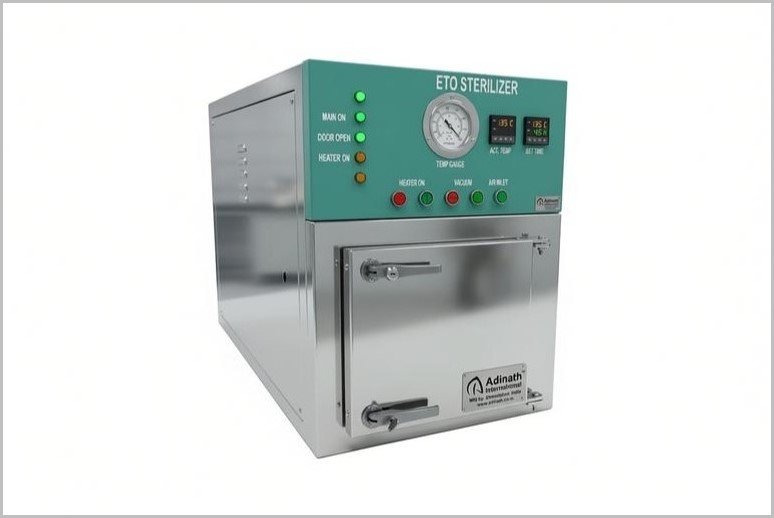

A steam sterilizer, commonly referred to as an autoclave, is a dependable and well-established machine that uses high-pressure steam to eliminate all kinds of microorganisms, such as bacteria, viruses, fungi, and spores. It functions by exposing contaminated instruments, tools, and materials to high temperatures, typically ranging from 121°C (250°F) to 134°C (273°F), under pressure for a set duration. This process causes the proteins in microorganisms to denature and break down, leading to their complete destruction. This technique has been crucial in preventing infections for over a century and continues to be widely used in medical facilities and laboratories worldwide.
Steam sterilization relies on the effectiveness of moist heat under pressure. When steam comes into contact with cooler items inside the chamber, it condenses into water, which releases heat and rapidly warms the load. The combination of high temperature, moisture, and pressure enables the sterilization of materials that are porous, wrapped, or have intricate structures—something that dry heat or chemical methods struggle to achieve.
Modern steam sterilizers feature advanced technologies like vacuum systems, including pre-vacuum and gravity displacement, digital controls, Bowie-Dick testing, and biological indicators.
The principle of steam sterilization is pivoted on exposing objects to steam for a pre-specified amount of time and temperature. This equipment is uses in medical facilities to sterilize the surface of wrapped goods or hollow objects. There are three key parameters in steam sterilization: temperature, steam under pressure and time.
Dry and saturated steam is supplied under a particular pressure into the autoclave. Microorganisms are eliminated due to the heat from condensation. This happens due to an irreversible damage caused to the cells of microorganisms because of coagulation.
Construction | Standard Model | Double Walled Model | Triple Walled Model |
MOC Exterior | MS Painted | SS 304 (mirror finish) | SS 304 mirror finish) |
No. of walls | Double | Double | Triple |
Lid | Polished MS | SS 304 | SS 304 |
Interior | SS 304 with silicon gasket | ||
Working Pressure | 15 to 20 PSI | ||
Working Temperature | 121°C to 125°C | ||
Controller | 15 PSI & 121°C | ||
Pressure display | Analog dial gauge. | ||
Timer | Mechanical timer | ||
Hydraulic tested | Hydraulically Tested up to 40 psi. | ||
Basket | Stainless steel basket | Stainless steel basket | Not Required |
Power supply | 220 Volts, Single Phase, 50Hz | ||
Standard Fittings |
| ||
Optional Accessories |
| ||
* Power voltage can be adjusted as per customer’s domestic power voltage requirements.
* Rights of technical improvements & modification reserved.
* Illustrations & dimensions are shown for information purpose only.
Modern units feature microprocessors for automated cycles, safety interlocks, and data logging for compliance.
A steam sterilizer (also called an autoclave) uses high-pressure saturated steam to eliminate bacteria, viruses, fungi, and spores. Items are exposed to temperatures typically between 121°C and 134°C under pressure. When steam contacts cooler surfaces it condenses, releasing latent heat that denatures microbial proteins and destroys them. Key parameters are temperature, steam pressure, and time.
The sterilizer operates at working temperatures of 121°C to 125°C (extendable to 134°C in optional configurations) and pressures of 15–20 PSI (up to 15–30 PSI in key specifications). The chamber is hydraulically tested up to 40 PSI for safety.
Models are offered in standard, double-walled, and triple-walled constructions. The interior chamber is fabricated from stainless steel (SS 304) with a high-quality silicone rubber gasket. Exterior options include mild steel painted or SS 304 mirror finish, and lids are available in polished MS or SS 304.
Key features include a microprocessor-based digital temperature controller with real-time digital display, ISI-certified immersion heaters, fully automatic pressure regulation, durable steam pressure gauges, water-level sight glass, foot-operated pedal for lid opening, and dedicated valves for water filling and drainage.
Cycle times generally range from 15 to 60 minutes, plus preheating and cooling periods, depending on the load type, temperature selected, and whether pre-vacuum or gravity displacement is used.
Steam sterilization is especially effective for porous materials, wrapped goods, hollow instruments, and items with complex geometries—applications where dry heat or chemical methods are less reliable. The stainless-steel chamber provides durability and corrosion resistance for repeated use with such loads.
Safety provisions include automatic pressure regulation and shut-off, spring-loaded safety valves, pressure-relief mechanisms, water-level sensors/indicators, low-water cut-off (optional), alarms, and a hydraulically tested chamber rated well above working pressure.
Optional features include fully stainless-steel (GMP) construction, PID temperature controller with timer and buzzer, PLC with HMI interface and data logging, 21 CFR Part 11 compliant software, thermal printer, and capability to reach 134°C.
It is widely applied in the pharmaceutical, nutraceutical, herbal, Ayurvedic, biotech, cosmetic, and chemical industries for sterilizing instruments, tools, materials, and process equipment.
Standard power supply is 220 V, single phase, 50 Hz (adjustable to customer requirements). Standard fittings include a low-water indicator, automatic pressure switch, pedal lifting device, steam release valve, water outlet valve, spring-loaded safety valve, and power cable with three-pin plug. Stainless-steel baskets are supplied with most models.
More Sterilization Equipments
 Horizontal Rectangular Steam Sterilizer
 2 Cubic Feet EO Gas Sterilizer
 2 Cubic Feet Sterilizer
 3 Cubic Feet EO Sterilizer
Algeria | Angola | Argentina | Australia | Austria | Bahrain | Bangladesh | Belarus | Belgium | Bolivia | Botswana | Brazil | Bulgaria | Canada | Chile | China | Colombia | Costa Rica | Cuba | Czech Republic | Denmark | Dominican Republic | Ecuador | Egypt | El Salvador | Ethiopia | Finland | France | Germany | Ghana | Greece | Guatemala | Haiti | Honduras | Hong Kong | Hungary | India | Indonesia | Iran | Ireland | Israel | Italy | Ivory Coast | Japan | Jordan | Kazakhstan | Kenya | Kuwait | Lebanon | Libya | Malaysia | Mexico | Mongolia | Morocco | Mozambique | Myanmar | Netherlands | New Zealand | Nicaragua | Nigeria | Norway | Oman | Pakistan | Panama | Paraguay | Peru | Philippines | Poland | Portugal | Qatar | Romania | Russia | Saudi Arabia | Senegal | Slovakia | Singapore | South Africa | South Korea | South Sudan | Spain | Sri Lanka | Sweden | Switzerland | Taiwan | Tanzania | Thailand | Trinidad and Tobago | Tunisia | Turkey | Uganda | Ukraine | United Arab Emirates | United Kingdom | United States | Uruguay | Uzbekistan | Venezuela | Vietnam | Zambia | Zimbabwe
Connect with our engineering team to discuss your specific production requirements. We provide customized, cGMP-compliant machinery solutions designed to optimize your manufacturing facility and maximize output.
©Adinath International | Theme Developed By Pharma Machinery Manufacturer I Website updated on: 15 October 2026
Request A Quick Quote
Steam Sterilizer
Please drop your requirements, one of our technical expert will contact you in next 24 working hours.
WhatsApp us
