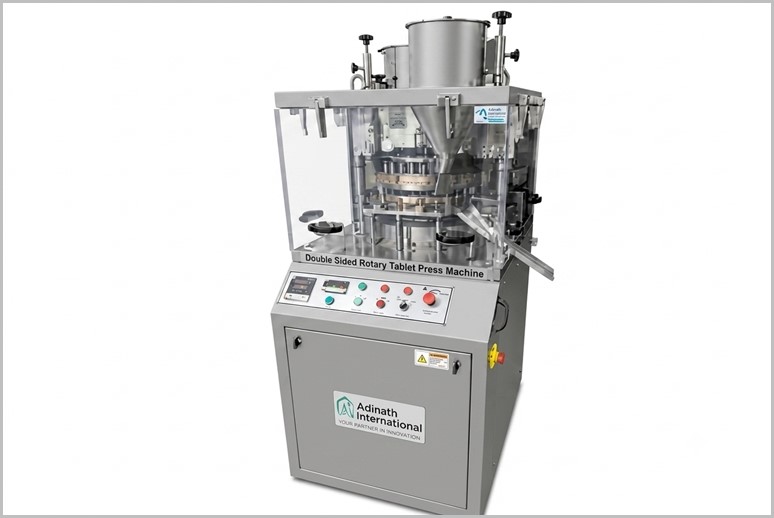
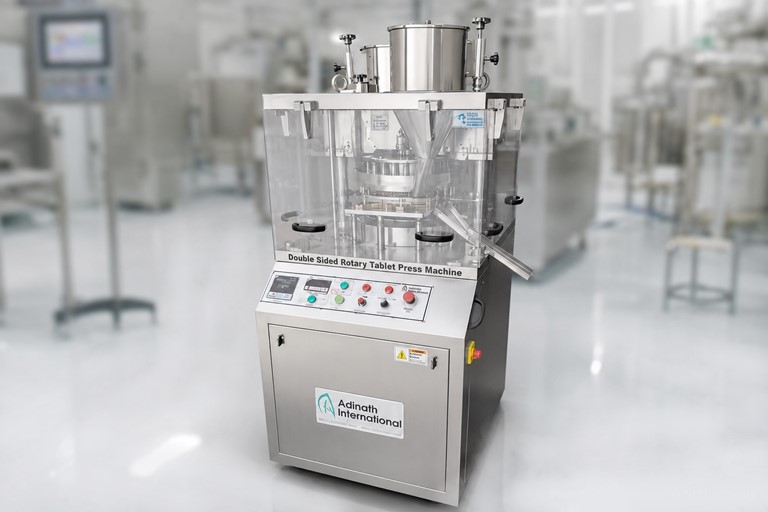
Salt Tablet Press Machine is a specialized industrial equipment designed to compress granulated or powdered salt into uniform, solid tablets or blocks. These machines are essential in industries like water treatment, food processing, and pharmaceuticals, where salt tablets are used for applications such as water softening, dishwashing, animal feed supplements, or effervescent formulations. Unlike standard tablet presses, salt-specific models are built with enhanced corrosion resistance due to salt’s abrasive and corrosive nature, ensuring durability and hygiene. They operate on principles of hydraulic or mechanical pressure to achieve precise tablet dimensions, weight, and hardness.
The process is automated and continuous for high-volume production:
If you need details on specific models and pricing, let me know!
Tablet compression machine basically works on hydraulic pressure. This pressure perform key role in any type of Tablet Machine. It transmitted unreduced through the static fluid. Any external applied pressure is transmitted through static fluid to all directions in the same proposition. which resulting make suitable to increase pressure. To form a tablet, the granulated powder material must be metered into a cavity formed by two punches and a die, and then the punches must be pressed together with great force to fuse the material together. There are two types of tablet presses called Single Station Tablet Press and Multi Station Tablet Press. Working of these machines differs in terms of production output and feature requirements.
Model | 16D | 20D | 24D | 37D |
Number of Stations | 16 | 20 | 24 | 37 |
Type of Tooling Punch | D | D | DB | D |
Output – Tablets / hour approx. | 13,440 – 40,320 | 16,800 – 50,400 | 19,320 – 57,950 | 222000 |
Max. Operating Pressure | 100 KN | 100 KN | 65 KN | 100 KN |
Max. Tablet Dia | 25mm | 25mm | 16mm | 25mm |
Max. Depth of fill | 20.5 mm | 20.5 mm | 17.5 mm | 20mm |
Upper Punch Penetration | 1.5 – 8 mm | 1.5 – 8 mm | 1.5 – 8 mm | 3 – 6mm |
Main Electric Motor | 3 H.P., 1440 RPM, 415 V., 3 Phase, 50 Hz. | 3 H.P., 1440 RPM, 415 V., 3 Phase, 50 Hz. | 3 H.P., 1440 RPM, 415 V., 3 Phase, 50 Hz. | 9 H.P., 1440 RPM, 415 V., 3 Phase, 50 Hz. |
Overall Dimension (cm) approx. | 98 x 102 x 182 H | 98 x 102 x 182 H | 98 x 102 x 182 H | 167 x 183 x 215 |
Net Weight (Kgs) approx. | 1150 | 1150 | 1150 | 2500 |
* Power voltage can be adjusted as per customer’s domestic power voltage requirements.
* Rights of technical improvements & modification reserved.
* Illustrations & dimensions are shown for information purpose only.
A Salt Tablet Press Machine is a specialized industrial equipment designed to compress granulated or powdered salt into uniform, solid tablets or blocks. It is widely used in water treatment (softening), food processing, dishwashing, animal feed supplements, pharmaceuticals, and chemical industries. These machines feature enhanced corrosion-resistant construction (e.g., SS 316 contact parts) to handle salt’s abrasive and hygroscopic properties, ensuring durability, hygiene, and cGMP compliance.
The machine operates on the principle of hydraulic or mechanical pressure. Granulated salt is fed from the hopper into the die cavity. Upper and lower punches apply pre-compression (to remove air) and main compression forces to form solid tablets. In rotary models, a rotating turret with multiple stations enables continuous high-speed production. Finished tablets are ejected, with adjustable controls for thickness, diameter, and hardness.
Key features include a compact GMP model, powerful pre- and main compression forces (up to 100 KN), oil-immersed gearbox-driven turret (up to 70 RPM), auto lubrication, hydro-pneumatic pressure control, upper punch penetration adjustment, VFD-driven motors, electronic tablet counter, safety interlocks, and optional two-layer compression, PLC/HMI, and pneumatic powder loading. It supports D, B, and BB tooling.
The machine is available in models such as 16D, 20D, 24D, and 37D, with outputs ranging from approximately 13,440 to 222,000 tablets per hour. Key specs include max compression force up to 100 KN, max tablet diameter up to 25mm, max fill depth up to 20.5mm, and support for various tablet shapes (round, geometric, imprinted). Power and dimensions vary by model (e.g., 3–9 H.P. motor).
Advantages include high output and scalability, uniform tablet quality with consistent hardness and dissolution, corrosion resistance for longer machine life, reduced material wastage, easy tooling changeover, low maintenance, and full cGMP compliance. It is ideal for high-volume production in water treatment, food, and chemical industries while maintaining precision and hygiene.
More Tablet Press Machines
 Chlorine Tablet Press Machine
 Confectionary Tablet Press Machine
 Flower Basket Tablet Press Machine
 GMP Tablet Press Machine
Algeria | Angola | Argentina | Australia | Austria | Bahrain | Bangladesh | Belarus | Belgium | Bolivia | Botswana | Brazil | Bulgaria | Canada | Chile | China | Colombia | Costa Rica | Cuba | Czech Republic | Denmark | Dominican Republic | Ecuador | Egypt | El Salvador | Ethiopia | Finland | France | Germany | Ghana | Greece | Guatemala | Haiti | Honduras | Hong Kong | Hungary | India | Indonesia | Iran | Ireland | Israel | Italy | Ivory Coast | Japan | Jordan | Kazakhstan | Kenya | Kuwait | Lebanon | Libya | Malaysia | Mexico | Mongolia | Morocco | Mozambique | Myanmar | Netherlands | New Zealand | Nicaragua | Nigeria | Norway | Oman | Pakistan | Panama | Paraguay | Peru | Philippines | Poland | Portugal | Qatar | Romania | Russia | Saudi Arabia | Senegal | Slovakia | Singapore | South Africa | South Korea | South Sudan | Spain | Sri Lanka | Sweden | Switzerland | Taiwan | Tanzania | Thailand | Trinidad and Tobago | Tunisia | Turkey | Uganda | Ukraine | United Arab Emirates | United Kingdom | United States | Uruguay | Uzbekistan | Venezuela | Vietnam | Zambia | Zimbabwe
Connect with our engineering team to discuss your specific production requirements. We provide customized, cGMP-compliant machinery solutions designed to optimize your manufacturing facility and maximize output.
©Adinath International | Theme Developed By Pharma Machinery Manufacturer I Website updated on: 15 October 2026
Request A Quick Quote
Salt Tablet Press Machine
Please drop your requirements, one of our technical expert will contact you in next 24 working hours.
WhatsApp us
