
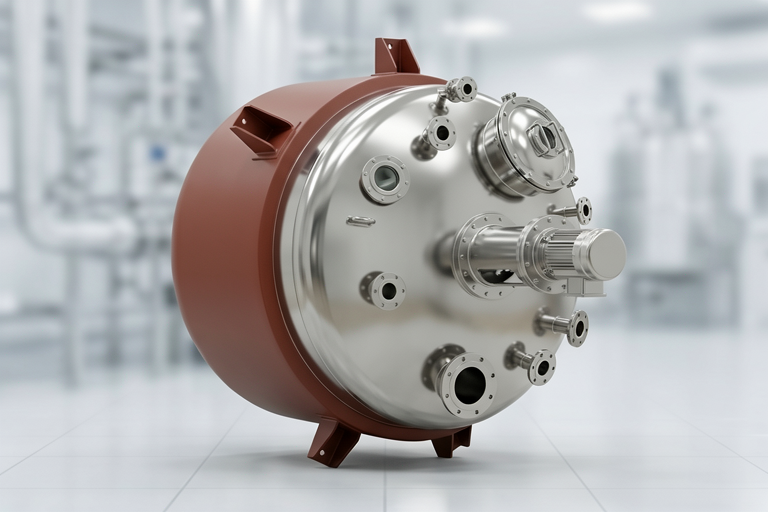
In the realm of chemical engineering and process industries, the jacketed agitated reactor (frequently referred to as a jacketed stirred tank reactor or double-walled vessel) serves as a foundational asset. Designed to handle complex chemical transformations under strict operational parameters, this specialized equipment ensures that reactions proceed safely, efficiently, and with high product yields.
Core Structural Architecture
The engineering design of a jacketed agitated reactor relies on two primary systems working in tandem: thermal regulation through the outer shell and mechanical homogenization via internal stirring.
A Jacketed Agitated Reactor (also known as a jacketed stirred tank reactor or double-walled vessel) is specialized process equipment designed for controlled chemical reactions. It combines an inner vessel that holds the reactants with an outer jacket for precise thermal regulation and an internal agitator for thorough mixing, ensuring safe, efficient reactions and high product yields.
The system operates through two integrated functions: thermal control and mechanical agitation. Heat transfer fluids (such as steam, cooling water, thermal oil, or glycol) circulate through the outer jacket to manage exothermic or endothermic reactions. Simultaneously, a motor-driven agitator with impellers, pitched blades, or turbines provides uniform mixing, improves mass transfer, accelerates reaction rates, and enhances heat transfer efficiency. Internal baffles prevent vortex formation and promote turbulence.
All product-contact parts are fabricated from high-grade stainless steel — SS 304, SS 316, or SS 316L — ensuring excellent corrosion resistance, hygiene, and compliance with industry standards. The design follows ASME guidelines for pressure and vacuum applications.
These reactors are offered in a wide range of capacities, from laboratory-scale 5 liters up to 50,000 liters. Larger industrial models can also be supplied in the 10–100 KL range, with fully customized sizes available based on process requirements.
The reactor features a jacketed or limpet coil design that allows efficient circulation of heating or cooling media such as steam, thermal oil, hot/cold water, or glycol. This enables precise temperature control for both exothermic and endothermic reactions.
Yes. The reactors are designed to be fully compatible with both vacuum and pressurized operations. They typically withstand vacuum levels of 650–700 mm Hg and pressures up to 3 bar above atmospheric, making them suitable for a wide range of process conditions.
Key safety and control options include provision for a rupture disc, inert gas blanketing, dual temperature measurement (jacket and product at multiple levels), mechanical seals, Variable Frequency Drive (VFD) for speed control, flameproof/explosion-proof motors, and optional PLC-based automatic controls.
The primary components include the inner vessel (holds reactants), outer jacket (for thermal fluid circulation), agitator shaft with impeller, inlet/outlet nozzles, vents, thermowells, condensers, and optional internal coils, vacuum insulation, or scraper blades for handling viscous materials.
It is widely used across the pharmaceutical, nutraceutical, herbal, Ayurvedic, biotech, cosmetic, and chemical industries for processes that require precise temperature control, uniform mixing, and safe handling of chemical reactions or formulations.
Major advantages include precise thermal management, excellent mixing and homogeneity, high reaction efficiency and product yields, compatibility with vacuum/pressure/inert gas operations, robust ASME-compliant construction, low residual product hold-up (with flush bottom valve option), and flexibility for both standard and vacuum-rated applications.
More Other Machines
 Jacketed Reactor For Resin Paints
 Stainless Steel Jacketed Reactor With Limpet Coil
 Acrylic Resin Reactor
 Alkyd Resin Reactor
Algeria | Angola | Argentina | Australia | Austria | Bahrain | Bangladesh | Belarus | Belgium | Bolivia | Botswana | Brazil | Bulgaria | Canada | Chile | China | Colombia | Costa Rica | Cuba | Czech Republic | Denmark | Dominican Republic | Ecuador | Egypt | El Salvador | Ethiopia | Finland | France | Germany | Ghana | Greece | Guatemala | Haiti | Honduras | Hong Kong | Hungary | India | Indonesia | Iran | Ireland | Israel | Italy | Ivory Coast | Japan | Jordan | Kazakhstan | Kenya | Kuwait | Lebanon | Libya | Malaysia | Mexico | Mongolia | Morocco | Mozambique | Myanmar | Netherlands | New Zealand | Nicaragua | Nigeria | Norway | Oman | Pakistan | Panama | Paraguay | Peru | Philippines | Poland | Portugal | Qatar | Romania | Russia | Saudi Arabia | Senegal | Slovakia | Singapore | South Africa | South Korea | South Sudan | Spain | Sri Lanka | Sweden | Switzerland | Taiwan | Tanzania | Thailand | Trinidad and Tobago | Tunisia | Turkey | Uganda | Ukraine | United Arab Emirates | United Kingdom | United States | Uruguay | Uzbekistan | Venezuela | Vietnam | Zambia | Zimbabwe
Connect with our engineering team to discuss your specific production requirements. We provide customized, cGMP-compliant machinery solutions designed to optimize your manufacturing facility and maximize output.
©Adinath International | Theme Developed By Pharma Machinery Manufacturer I Website updated on: 15 October 2026
Request A Quick Quote
Jacketed Agitated Reactor
Please drop your requirements, one of our technical expert will contact you in next 24 working hours.
WhatsApp us
