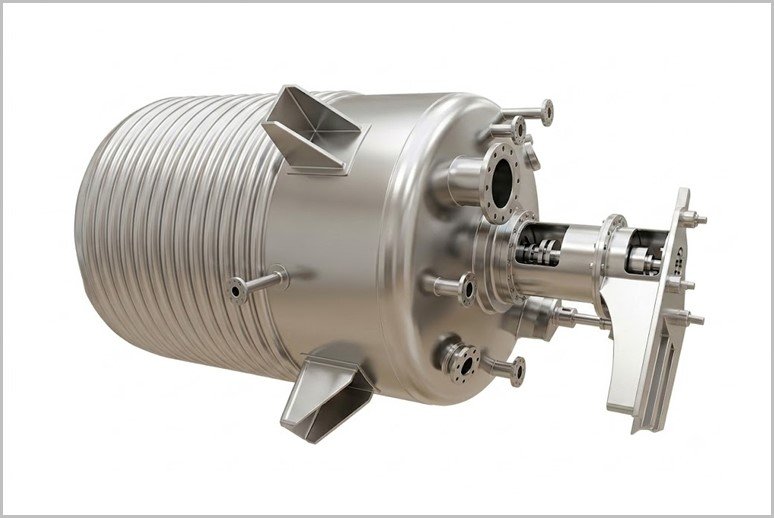
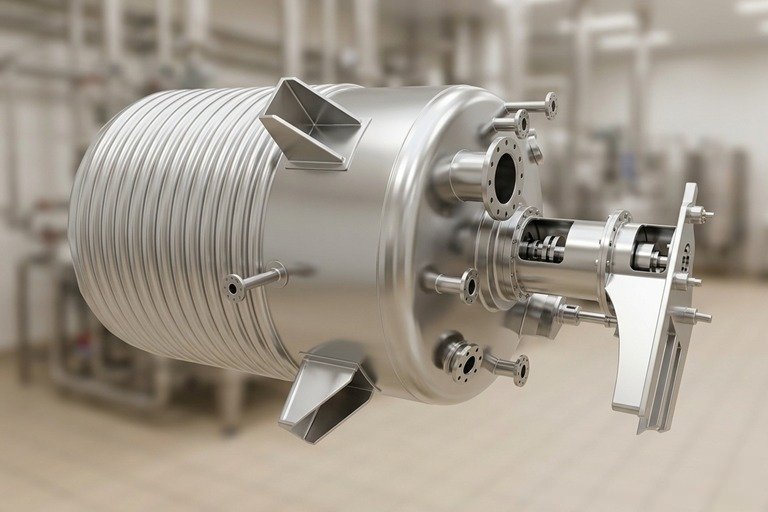
An Alkyd Resin Reactor is a sophisticated, heavy-duty chemical reaction vessel engineered specifically for the synthesis of alkyd resins. These vital synthetic resins are polyester polymers modified with fatty acids or drying/non-drying oils, forming the backbone of the global paint, coating, and industrial enamel industries. Achieving high-performance alkyd resins demands precise thermal control, robust mechanical agitation, and efficient byproduct management. This technical guide explores the operational principles, engineering design, and critical importance of alkyd resin reactors in modern chemical processing.
What is an Alkyd Resin Reactor?
At its core, an alkyd resin reactor is a pressure- and temperature-rated vessel—typically constructed from high-grade stainless steel (such as 304 or 316L) to resist corrosive organic acids. It serves as the controlled environment where polycondensation (esterification) reactions take place.
These specialized systems are designed to handle complex multi-phase chemical mixtures at elevated temperatures, often ranging from 200°C to 260°C. Because the manufacturing process requires uniform heat distribution and the management of viscous fluids, these reactors integrate advanced heating jackets, specialized agitators, and automated control systems.
Industry Best Practices and Expertise in Reactor Operation
Operating an alkyd resin reactor successfully requires deep chemical engineering expertise and strict adherence to safety and quality standards. Experienced manufacturers implement rigorous in-process quality control—monitoring acid values, Gardner color scales, and viscosity benchmarks in real-time. By combining advanced process automation with robust vessel design, chemical plants achieve optimal batch reproducibility, minimizing waste and maximizing the performance characteristics of the final alkyd resin.
An Alkyd Resin Reactor is a sophisticated, heavy-duty chemical reaction vessel engineered specifically for the synthesis of alkyd resins. These are polyester polymers modified with fatty acids or drying/non-drying oils that form the backbone of the paint, coating, and industrial enamel industries. It provides a controlled environment for polycondensation (esterification) reactions.
It is typically fabricated entirely from premium stainless-steel grades such as SS 304, SS 316, or SS 316L, often with mirror or sanitary internal finishes. These materials resist aggressive organic acids, polybasic acids, and corrosive chemical vapors at elevated temperatures, preventing product contamination and vessel degradation.
These reactors are designed for elevated operating temperatures, commonly ranging from 200°C to 260°C (with process examples noting gradual heating to 180–220°C). Specialized heating systems ensure precise thermal control throughout the batch.
It is equipped with specialized heating jackets—such as conventional jackets, dimple jackets, or internal half-pipe coils—coupled with high-temperature thermal oil circulation systems or electric induction heating. This provides uniform heat distribution across the batch, eliminating hot spots and preventing localized charring, premature gelling, or thermal degradation of the resin.
Robust high-torque motors, hardened gearboxes, and specialized internal impellers (such as anchor, turbine, or helical ribbon blades) are used for high-viscosity tracking. They ensure thorough homogenization of multi-phase liquid-solid-gas mixtures and maintain stable mass transfer as the polymer batch thickens during the reaction.
It features overhead condensers, fractionating columns, and decanters designed to continuously remove water generated during the polycondensation (esterification) process. This efficiently strips out reaction water to drive the reversible esterification reaction forward while condensing and returning volatile raw materials back into the vessel.
Raw materials are charged into the reactor, heated gradually (e.g., to 180–220°C) with stirring, and water is removed via distillation (solvent process) or fusion (no solvent). The reaction is monitored by acid value and viscosity. The batch is then cooled, thinned with solvent, filtered, and packaged.
It ensures uniform heat distribution to avoid degradation, handles high-viscosity multi-phase mixtures effectively, enables efficient byproduct (water) management to drive the reaction forward, resists corrosive chemicals, and supports precise process control. This leads to optimal batch reproducibility, minimized waste, and high-performance resin characteristics.
They are usually batch or semi-batch stirred tank reactors with capacities ranging from laboratory-scale to industrial sizes (typically 1,000–10,000 gallons or liters), allowing flexibility for different production needs.
Experienced operation involves rigorous in-process quality control, including real-time monitoring of acid values, Gardner color scales, and viscosity benchmarks. Advanced process automation combined with robust vessel design helps achieve consistent batch reproducibility and maximizes the performance of the final alkyd resin.
More Other Machines
 Reactor For Alkyd Resin
 Acrylic Resin Reactor
 Jacketed Reactor For Resin Paints
 Oil Heating Resin Reactor
Algeria | Angola | Argentina | Australia | Austria | Bahrain | Bangladesh | Belarus | Belgium | Bolivia | Botswana | Brazil | Bulgaria | Canada | Chile | China | Colombia | Costa Rica | Cuba | Czech Republic | Denmark | Dominican Republic | Ecuador | Egypt | El Salvador | Ethiopia | Finland | France | Germany | Ghana | Greece | Guatemala | Haiti | Honduras | Hong Kong | Hungary | India | Indonesia | Iran | Ireland | Israel | Italy | Ivory Coast | Japan | Jordan | Kazakhstan | Kenya | Kuwait | Lebanon | Libya | Malaysia | Mexico | Mongolia | Morocco | Mozambique | Myanmar | Netherlands | New Zealand | Nicaragua | Nigeria | Norway | Oman | Pakistan | Panama | Paraguay | Peru | Philippines | Poland | Portugal | Qatar | Romania | Russia | Saudi Arabia | Senegal | Slovakia | Singapore | South Africa | South Korea | South Sudan | Spain | Sri Lanka | Sweden | Switzerland | Taiwan | Tanzania | Thailand | Trinidad and Tobago | Tunisia | Turkey | Uganda | Ukraine | United Arab Emirates | United Kingdom | United States | Uruguay | Uzbekistan | Venezuela | Vietnam | Zambia | Zimbabwe
Connect with our engineering team to discuss your specific production requirements. We provide customized, cGMP-compliant machinery solutions designed to optimize your manufacturing facility and maximize output.
©Adinath International | Theme Developed By Pharma Machinery Manufacturer I Website updated on: 15 October 2026
Request A Quick Quote
Alkyd Resin Reactor
Please drop your requirements, one of our technical expert will contact you in next 24 working hours.
WhatsApp us
