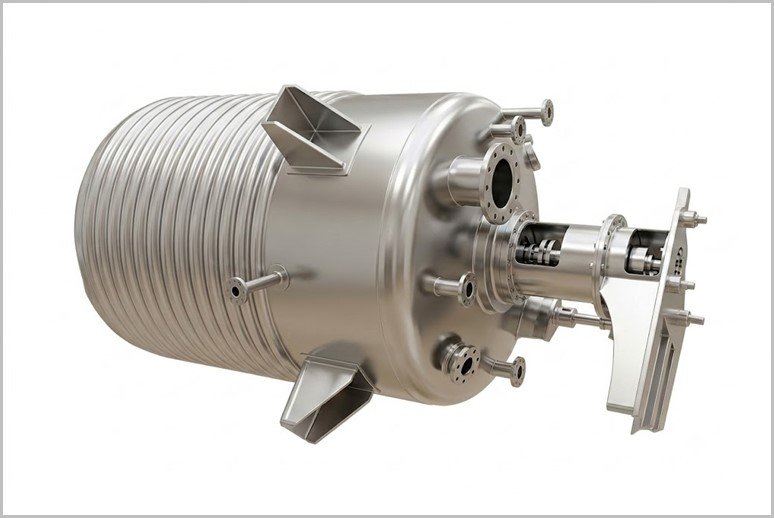
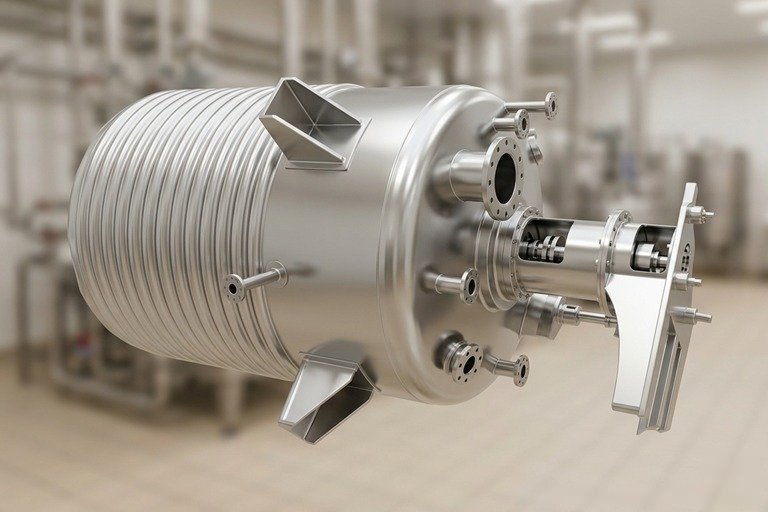
An Unsaturated Polyester Resin Reactor is an advanced, heavy-duty chemical processing system engineered specifically for the synthesis of unsaturated polyester resin (UPR). As a foundational thermosetting polymer, UPR serves as the backbone for high-performance composite materials, protective coatings, and fiberglass-reinforced plastics (FRP). Optimizing the design and operation of these industrial reactors is critical for chemical manufacturers aiming to achieve precise molecular weight, exceptional mechanical strength, and reliable cross-linking capabilities.
What is an Unsaturated Polyester Resin Reactor?
Production Process Overview
The manufacturing of UPR typically involves a batch polycondensation reaction:
This process requires precise control of temperature, pressure (often under vacuum in later stages), and agitation to ensure uniform reaction and product quality.
UPR reactors are typically jacketed stainless steel batch reactors (often made of SUS316L for corrosion resistance) with capacities ranging from pilot-scale to industrial. Key components include:
An Unsaturated Polyester Resin Reactor is a specialized, heavy-duty chemical processing system designed for the synthesis of unsaturated polyester resin (UPR). It enables controlled polycondensation and esterification reactions by combining glycols (such as propylene glycol or ethylene glycol) with unsaturated dicarboxylic acids or anhydrides (like maleic anhydride and phthalic anhydride) to produce durable, cross-linkable polymer networks used in composites, coatings, and fiberglass-reinforced plastics (FRP).
The reactor is typically fabricated from high-grade stainless steel (SS 316 / SS 316L) to resist aggressive organic acids and glycols at elevated temperatures. For highly corrosive formulations or specialized catalysts, wetted parts can be upgraded to Hastelloy or Inconel. Internal contact surfaces are mirror-polished (often Ra < 0.5 µm) to prevent product adhesion and simplify cleaning.
UPR synthesis requires precise heating profiles, often ramping up to 200°C–250°C, followed by rapid cooling to quench the exothermic reaction at the target acid value and viscosity. The system uses high-temperature thermic fluid or steam for heating and cooling water for quenching, ensuring rapid thermal transfer and exact temperature control.
The reactor is equipped with specialized agitators—such as anchor, pitched blade, or dual-shaft configurations—designed to manage the dramatic viscosity increase as monomers polymerize into high-molecular-weight resins. These agitators deliver continuous torque under heavy loads and are paired with explosion-proof (flameproof/Ex-proof) motors suitable for volatile solvent environments.
A condenser/reflux system separates and refluxes unreacted glycols while continuously distilling off the water of esterification. It efficiently condenses water vapor and volatile byproducts, and a collection system accurately measures the distillate to monitor reaction progress via water-of-reaction mass balance, driving the polycondensation forward.
Nitrogen blanketing maintains an oxygen-free, inert atmosphere inside the vessel to prevent premature cross-linking, discoloration, and oxidation of the batch. Full vacuum capability allows effective stripping of residual moisture, volatile monomers, or low-boiling impurities during the final stages of processing, helping achieve higher molecular weight and product purity.
The reactor incorporates crucial pressure-relief devices (safety valves) to handle unexpected exothermic runaways or sudden pressure spikes. Explosion-proof motors and robust construction further enhance operational safety in chemical handling environments involving volatile solvents and aggressive reactants.
It prevents chemical degradation and maintains product purity when handling aggressive acids and glycols; enables exact temperature profiling and rapid quenching for safe control of exothermic reactions; smoothly handles viscosity increases with heavy-duty agitators; accurately removes water of reaction; uses nitrogen blanketing to avoid oxidation and premature cross-linking; and operates under full vacuum to eliminate residual impurities.
Key components include a jacketed stainless steel batch reactor vessel (vertical or horizontal) for heating/cooling; an agitator/mixer (anchor, propeller, or impeller type); a condenser system (often with fractionation column or water separator); precise heating/cooling systems (thermic fluid or steam); vacuum capability; and auxiliary equipment such as dilution kettles (for adding styrene), buffer tanks, high-position feed tanks, and oil-water separators. Capacities range from pilot-scale to full industrial production.
It is primarily used in the chemical industry for producing unsaturated polyester resins that serve as the backbone for high-performance composite materials, protective coatings, and fiberglass-reinforced plastics (FRP). Related applications extend to sectors requiring durable thermosetting polymers, with the broader manufacturing context also supporting pharmaceutical, nutraceutical, herbal, Ayurvedic, biotech, and cosmetic industries through associated equipment lines.
More Other Machines
 Acrylic Resin Reactor
 Alkyd Resin Reactor
 Jacketed Reactor For Resin Paints
 Oil Heating Resin Reactor
Algeria | Angola | Argentina | Australia | Austria | Bahrain | Bangladesh | Belarus | Belgium | Bolivia | Botswana | Brazil | Bulgaria | Canada | Chile | China | Colombia | Costa Rica | Cuba | Czech Republic | Denmark | Dominican Republic | Ecuador | Egypt | El Salvador | Ethiopia | Finland | France | Germany | Ghana | Greece | Guatemala | Haiti | Honduras | Hong Kong | Hungary | India | Indonesia | Iran | Ireland | Israel | Italy | Ivory Coast | Japan | Jordan | Kazakhstan | Kenya | Kuwait | Lebanon | Libya | Malaysia | Mexico | Mongolia | Morocco | Mozambique | Myanmar | Netherlands | New Zealand | Nicaragua | Nigeria | Norway | Oman | Pakistan | Panama | Paraguay | Peru | Philippines | Poland | Portugal | Qatar | Romania | Russia | Saudi Arabia | Senegal | Slovakia | Singapore | South Africa | South Korea | South Sudan | Spain | Sri Lanka | Sweden | Switzerland | Taiwan | Tanzania | Thailand | Trinidad and Tobago | Tunisia | Turkey | Uganda | Ukraine | United Arab Emirates | United Kingdom | United States | Uruguay | Uzbekistan | Venezuela | Vietnam | Zambia | Zimbabwe
Connect with our engineering team to discuss your specific production requirements. We provide customized, cGMP-compliant machinery solutions designed to optimize your manufacturing facility and maximize output.
©Adinath International | Theme Developed By Pharma Machinery Manufacturer I Website updated on: 15 October 2026
Request A Quick Quote
Unsaturated Polyester Resin Reactor
Please drop your requirements, one of our technical expert will contact you in next 24 working hours.
WhatsApp us
