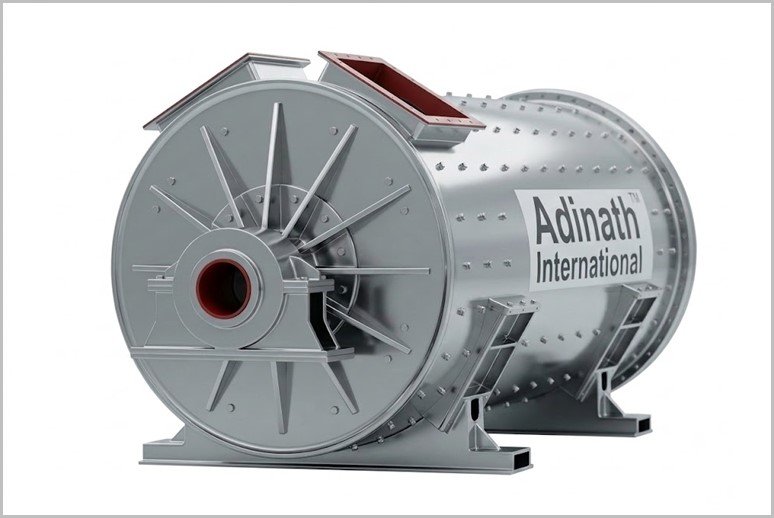
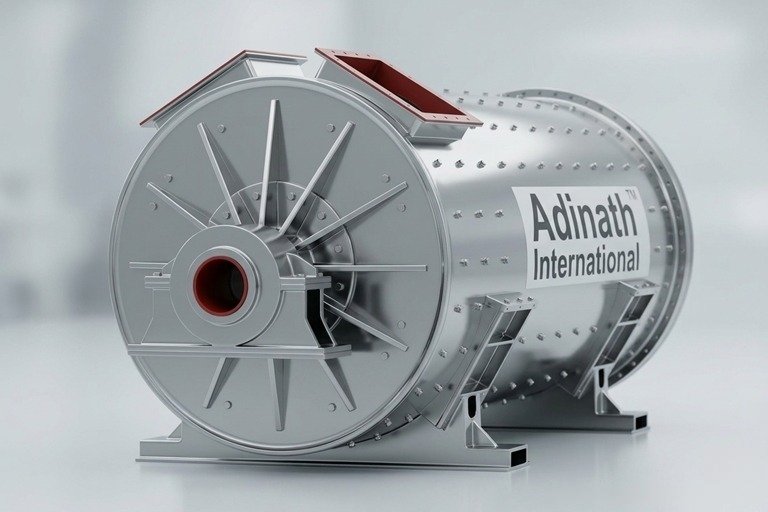
A continuous ball mill is a highly efficient grinding machine engineered for nonstop operation in demanding industrial environments. In this advanced system, raw materials are fed continuously into one end of the rotating cylindrical drum, where they are progressively ground into finer particles by the impact and attrition of grinding media—typically steel balls, ceramic balls, or other specialized media. The finely ground material is then discharged from the other end without ever stopping the process.
Unlike traditional batch ball mills, which process materials in discrete loads and require downtime for loading, unloading, and cleaning, continuous ball mills deliver seamless, high-throughput production. This design makes them the preferred choice for large-scale manufacturing operations where consistency, efficiency, and productivity are critical.
The mill consists of a horizontal rotating cylinder (drum) partially filled with grinding media. As the cylinder rotates:
This design ensures consistent particle size and higher efficiency compared to batch systems.
A continuous ball mill is a high-efficiency industrial grinding machine designed for nonstop operation. Raw materials are fed continuously into one end of a rotating cylindrical drum, ground by the impact and attrition of grinding media (such as steel, ceramic, or high-alumina balls), and discharged as fine powder from the other end without interrupting the process.
The mill consists of a horizontal rotating cylinder partially filled with grinding media. As the cylinder rotates, the balls cascade and tumble, generating impact, friction, and attrition forces that crush and grind the material. Feed enters via an inlet (often a conical trunnion), moves through the mill by gravity and rotation, and exits through a discharge outlet (grate, overflow, or peripheral). It supports wet or dry operation and open- or closed-circuit configurations.
Batch mills process materials in discrete loads and require downtime for loading, unloading, and cleaning. Continuous ball mills enable uninterrupted 24-hour operation with continuous feeding and discharging, delivering higher throughput, better consistency, and greater productivity for large-scale manufacturing.
Yes. Continuous ball mills are suitable for both dry and wet grinding of various materials, offering flexibility depending on the process requirements and material characteristics.
Particle size is adjusted by controlling the mill speed, grinding media size and type, feed rate, and residence time. The design also supports open-circuit or closed-circuit operation with classifiers for recirculation of oversized particles, ensuring uniform particle size distribution.
Common grinding media include steel balls, ceramic balls, and high-alumina balls. The choice depends on the material being ground, desired fineness, and contamination requirements.
Advantages include continuous 24-hour operation and high production efficiency, lower energy consumption compared to batch mills, uniform particle size distribution, replaceable wear-resistant liners (rubber, steel, or ceramic) for longer service life, robust construction, advanced PLC/digital automation for precise control, and easy maintenance with reliable long-term performance.
They are widely applied in the pharmaceutical, nutraceutical, herbal, Ayurvedic, biotech, cosmetic, and chemical industries for efficient grinding of various materials at scale.
In open-circuit mode, material passes through the mill once and is discharged. In closed-circuit mode, the mill works with classifiers that recirculate oversized particles back into the mill for further grinding, allowing tighter control over final particle size and higher efficiency.
They feature replaceable wear-resistant liners (rubber, steel, or ceramic) and durable grinding media. Combined with a robust horizontal cylindrical shell rotating on trunnions or rollers, advanced automation, and straightforward access, these design elements support easy maintenance, reliable performance, and extended equipment life.
Algeria | Angola | Argentina | Australia | Austria | Bahrain | Bangladesh | Belarus | Belgium | Bolivia | Botswana | Brazil | Bulgaria | Canada | Chile | China | Colombia | Costa Rica | Cuba | Czech Republic | Denmark | Dominican Republic | Ecuador | Egypt | El Salvador | Ethiopia | Finland | France | Germany | Ghana | Greece | Guatemala | Haiti | Honduras | Hong Kong | Hungary | India | Indonesia | Iran | Ireland | Israel | Italy | Ivory Coast | Japan | Jordan | Kazakhstan | Kenya | Kuwait | Lebanon | Libya | Malaysia | Mexico | Mongolia | Morocco | Mozambique | Myanmar | Netherlands | New Zealand | Nicaragua | Nigeria | Norway | Oman | Pakistan | Panama | Paraguay | Peru | Philippines | Poland | Portugal | Qatar | Romania | Russia | Saudi Arabia | Senegal | Slovakia | Singapore | South Africa | South Korea | South Sudan | Spain | Sri Lanka | Sweden | Switzerland | Taiwan | Tanzania | Thailand | Trinidad and Tobago | Tunisia | Turkey | Uganda | Ukraine | United Arab Emirates | United Kingdom | United States | Uruguay | Uzbekistan | Venezuela | Vietnam | Zambia | Zimbabwe
Connect with our engineering team to discuss your specific production requirements. We provide customized, cGMP-compliant machinery solutions designed to optimize your manufacturing facility and maximize output.
©Adinath International | Theme Developed By Pharma Machinery Manufacturer I Website updated on: 15 October 2026
Request A Quick Quote
Continuous Ball Mill for Grinding
Please drop your requirements, one of our technical expert will contact you in next 24 working hours.
WhatsApp us


