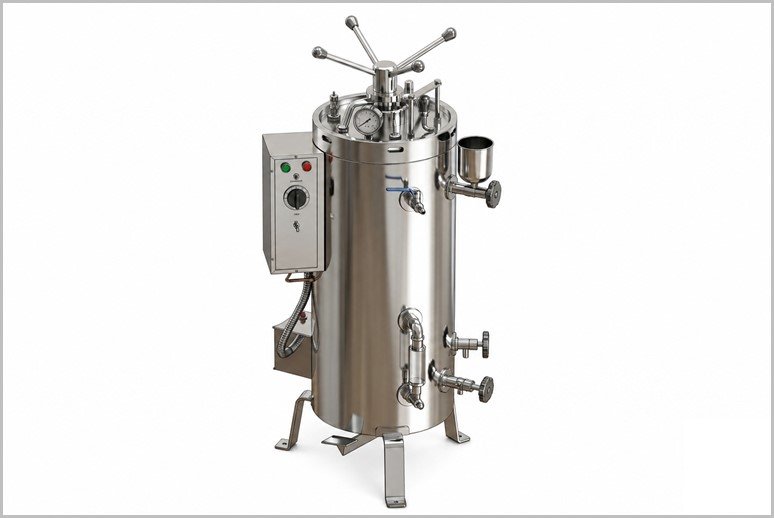
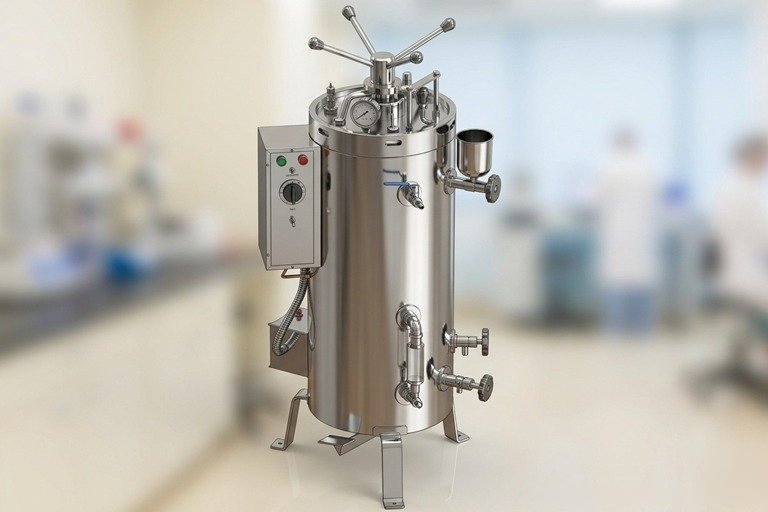
A Vertical Laboratory Autoclave is a top-loading steam sterilizer engineered for efficient, reliable sterilization in space-conscious laboratory environments. Also known as a vertical steam sterilizer, this compact design features a cylindrical chamber accessed from the top, distinguishing it from larger horizontal models. It is widely used in microbiology labs, research institutions, hospitals, pharmaceutical facilities, and educational settings where floor space is limited but high sterilization standards are non-negotiable.
Using high-pressure saturated steam, a Vertical Laboratory Autoclave effectively eliminates bacteria, viruses, fungi, and resistant spores from glassware, culture media, laboratory instruments, pipettes, and biohazardous waste. The moist heat process ensures deep penetration into liquids and porous materials, delivering consistent sterility with minimal risk of contamination.
The vertical configuration offers several practical advantages that experienced lab managers appreciate:
These sterilizers operate by generating saturated steam under pressure, typically at 121°C (15 psi) for standard cycles or 134°C (30 psi) for faster sterilization. Advanced models include programmable controls, pre-vacuum options, automatic pressure release, and digital displays with data logging for compliance and traceability. Safety features such as lid interlocks, over-pressure protection, and temperature sensors protect users and ensure process integrity.
It features a compact top-loading cylindrical chamber design that occupies a significantly smaller footprint than horizontal models. This makes it ideal for microbiology labs, research institutions, hospitals, pharmaceutical facilities, and educational settings where floor space is limited but reliable sterilization is essential.
It uses high-pressure saturated steam to eliminate bacteria, viruses, fungi, and resistant spores. The moist heat penetrates deeply into liquids, porous materials, glassware, culture media, laboratory instruments, pipettes, and biohazardous waste, delivering consistent sterility with minimal contamination risk.
The interior cavity is fabricated from high-grade stainless steel (typically SUS304) for corrosion resistance and longevity. Units are available in dual-walled or triple-walled structural configurations that improve thermal retention and operational safety.
It uses ISI-marked immersion or flanged heating elements for safe, dependable heat generation, an integrated digital indicator for real-time thermal monitoring, and an advanced electronic controller for precise temperature regulation. Reliable high-precision steam pressure gauges provide continuous safety verification.
A durable silicone rubber gasket creates an airtight, leak-proof seal during pressurization. Many models include a foot-pedal mechanism for convenient, hygienic lid opening, along with a screw-type or bolted lid that incorporates a safety valve to prevent over-pressurization.
Key protections include a clear water-level indicator to ensure proper water volume and prevent dry heating, an automatic pressure-control switch that maintains stable internal pressure, dedicated inlet and outlet valves for easy filling and drainage, pressure locks, overheat protection, and automatic exhaust systems.
A robust stainless-steel wire-mesh basket (or 1–2 baskets) is included for convenient loading, handling, and unloading of items. This supports efficient top-loading workflows and protects the chamber during use.
These autoclaves typically operate at 15–30 psi (1–2 bar) and temperatures of 121–134°C (250–273°F). Many models are designed to reach sterilization temperatures up to 121°C as a core operating range, with options for higher parameters when required.
It is widely used across the pharmaceutical, nutraceutical, herbal, Ayurvedic, biotech, cosmetic, and chemical industries, as well as in laboratories, hospitals, research facilities, and medical centers that require reliable infection control and contamination-free environments.
Modern units feature digital microprocessor or touchscreen controls for programming temperature, pressure, and cycle time, often with dual-scale gauges for real-time monitoring. They usually operate on a 230 V power supply and are available in mobile or benchtop configurations for flexible laboratory placement.
Algeria | Angola | Argentina | Australia | Austria | Bahrain | Bangladesh | Belarus | Belgium | Bolivia | Botswana | Brazil | Bulgaria | Canada | Chile | China | Colombia | Costa Rica | Cuba | Czech Republic | Denmark | Dominican Republic | Ecuador | Egypt | El Salvador | Ethiopia | Finland | France | Germany | Ghana | Greece | Guatemala | Haiti | Honduras | Hong Kong | Hungary | India | Indonesia | Iran | Ireland | Israel | Italy | Ivory Coast | Japan | Jordan | Kazakhstan | Kenya | Kuwait | Lebanon | Libya | Malaysia | Mexico | Mongolia | Morocco | Mozambique | Myanmar | Netherlands | New Zealand | Nicaragua | Nigeria | Norway | Oman | Pakistan | Panama | Paraguay | Peru | Philippines | Poland | Portugal | Qatar | Romania | Russia | Saudi Arabia | Senegal | Slovakia | Singapore | South Africa | South Korea | South Sudan | Spain | Sri Lanka | Sweden | Switzerland | Taiwan | Tanzania | Thailand | Trinidad and Tobago | Tunisia | Turkey | Uganda | Ukraine | United Arab Emirates | United Kingdom | United States | Uruguay | Uzbekistan | Venezuela | Vietnam | Zambia | Zimbabwe
Connect with our engineering team to discuss your specific production requirements. We provide customized, cGMP-compliant machinery solutions designed to optimize your manufacturing facility and maximize output.
©Adinath International | Theme Developed By Pharma Machinery Manufacturer I Website updated on: 15 October 2026
Request A Quick Quote
Vertical Laboratory Autoclave
Please drop your requirements, one of our technical expert will contact you in next 24 working hours.
WhatsApp us


