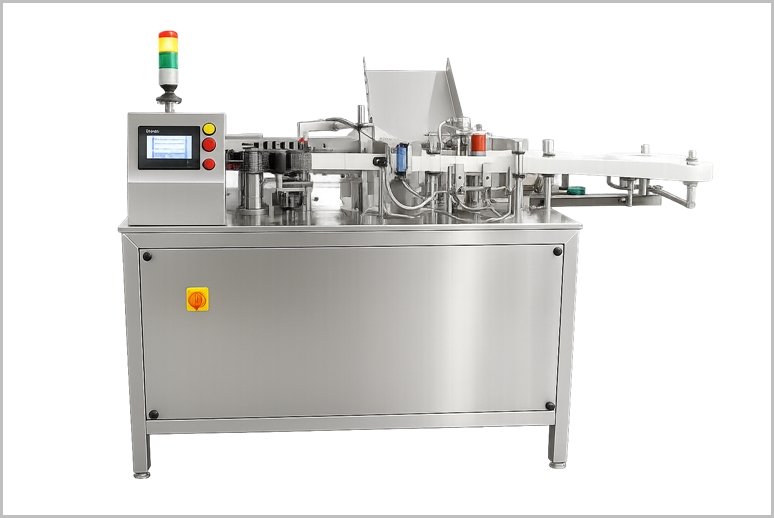
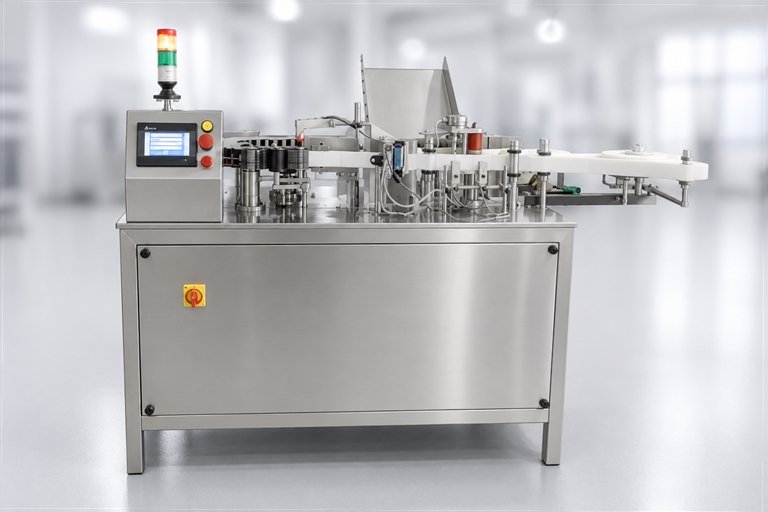
An ampoule labeling machine is a precise automated system designed for the pharmaceutical, medical, and cosmetics sectors. It is specifically built to apply adhesive labels to delicate, small-diameter containers like ampoules, vials, syringes, test tubes, and other cylindrical items that are challenging to label using standard labeling equipment.
These advanced machines ensure that important details such as product names, dosage instructions, batch numbers, manufacturing and expiry dates, barcodes, and compliance markings are consistently and accurately applied. They handle fragile glass or plastic ampoules with care, helping to minimize the chances of breakage, misalignment, or label wrinkling.
An ampoule is a sealed glass vial used to store sterile liquid medications. Due to their small size and horizontal position, traditional vertical labeling machines are not suitable for them. To address this, specialized ampoule labeling machines often use horizontal or rotary mechanisms that carefully rotate and secure the ampoules during the labeling process. This ensures fast, accurate labeling while preserving the integrity of the product.
For businesses seeking dependable ampoule labeling solutions, these machines offer increased production efficiency, adherence to regulations, and high-quality labels—key elements in today’s competitive pharmaceutical and healthcare packaging industry.
Ampoules are loaded onto infeed hopper of the machine from where it is delivered to the feedworm. Feed worm rotates ampoule and during its operation transfer the ampoules to the Starwheel. The Starhweel is having rollers of same diameter as of ampoule body diameter. Starwheel transfer ampoules to the labeling station where ampoule picks label one by one and further moves towards pressing unit. Pressing Unit equipped with rubber belt for proper placing the labels. During movement of ampoules from pressing belt ampoules get labeled.
Duly labeled ampoules get collected on Outfeed Collection Tray for further operation. In case of printing unit opted labels will be printed with printing device before applying onto ampoules. There are encoders installed which sense gap between two labels and accordingly provide signals to print data onto labels.
Model | AASL-120 | AASL-300 | AASL-600 |
Production Rate | Up to 120 Ampoules/Minute | Up to 300 Ampoules/Minute | Up to 600 Ampoules/Minute |
Type of Labels | Self-adhesive sticker labels | Self-adhesive sticker labels | Self-adhesive sticker labels |
Ampoule Diameter | 10mm to 18mm | 10mm to 18mm | 10mm to 18mm |
Ampoule Height | 50mm to 105mm | 50mm to 105mm | 50mm to 105mm |
Label Length | 20mm to 50mm | 20mm to 50mm | 20mm to 50mm |
Label Width | 15mm to 60mm | 15mm to 60mm | 15mm to 60mm |
Label Roll Core Diameter | 75 to 76mm | 75 to 76mm | 75 to 76mm |
Power Specification | 0.5 H.P. | 1 H.P. | 2 H.P. |
Electrical Characteristics | 230 Volts, Single Phase | 230 Volts, Single Phase | 230 Volts, Single Phase |
Overall Dimension | 1150mm (L) x 1100mm (W) x 1100mm (H) approx. | 1250mm (L) x 1100mm (W) x 1100mm (H) approx. | 1600mm (L) x 1400mm (W) x 1100mm (H) approx. |
* Power voltage can be adjusted as per customer’s domestic power voltage requirements.
* Rights of technical improvements & modification reserved.
* Illustrations & dimensions are shown for information purpose only.
Ampoule labeling machines are built to meet Good Manufacturing Practice (GMP) standards, with compact, ergonomic designs made from stainless steel (304/316 grade) for hygiene and durability. Common features include:
An ampoule labeling machine is a specialized automated system designed for applying self-adhesive sticker labels to small-diameter, fragile containers like glass or plastic ampoules, vials, syringes, and test tubes. Traditional vertical labeling machines are unsuitable due to the horizontal positioning and delicate nature of ampoules. These machines ensure accurate placement of critical information (batch numbers, expiry dates, barcodes, dosage) while minimizing breakage, misalignment, or wrinkling.
The machine is offered in three models:
These options support a wide range of production scales, from medium to high-volume pharmaceutical lines.
It accommodates ampoules with diameters of 10mm to 18mm and heights of 50mm to 105mm. Compatible label dimensions are 20mm–50mm in length and 15mm–60mm in width, with a label roll core diameter of 75–76mm. It also works with other similar cylindrical containers made of glass, plastic, or PET.
Ampoules are loaded into an infeed hopper and transferred via a feed worm (which rotates them) to a starwheel with matching-diameter rollers for precise alignment. At the labeling station, each ampoule picks up a self-adhesive label, which is then firmly secured by a secondary pressing unit with a rubber belt. Labeled ampoules are collected on an outfeed tray. Optional printing devices can add variable data (e.g., batch/mfg. date) before application.
It features a “No Ampoule – No Label” system, imported sensors for labels and containers, optional missing label and camera-based vision systems for print/barcode verification, safety guards, and GMP-compliant stainless steel construction. Faulty items can be rejected to maintain quality and compliance.
It is primarily used in the pharmaceutical industry for injectables and sterile products. It also serves nutraceutical, herbal/ayurvedic, biotech, cosmetic, food, and chemical industries handling small cylindrical containers.
Yes. Options include hopper or wire mesh conveyor feeding, batch printing devices, vision systems, voltage adjustments for local power supplies, and integration with upstream (filling/capping) and downstream (inspection/packaging) equipment via turntables. Modular designs support easy customization.
It includes an inbuilt PLC with a touch-screen HMI for intuitive operation, variable A.C. frequency drives for speed adjustment, an inbuilt speed indicator & counter, and easy changeover. Imported gear motors and sensors ensure reliable performance.
Key benefits include high speed (up to 600/min) with excellent accuracy, significant labor cost savings, minimal maintenance, gentle handling to reduce breakage of fragile ampoules, enhanced product safety and traceability, GMP/CE compliance, and modular customization for different production needs.
Power specifications vary by model (0.5 H.P. for AASL-120, 1 H.P. for AASL-300, 2 H.P. for AASL-600) with 230V single-phase electrical characteristics (servo motors with encoders). Dimensions range from approx. 1150mm(L) × 1100mm(W) × 1100mm(H) for the smallest model to 1600mm(L) × 1400mm(W) × 1100mm(H) for the largest. Voltage can be adjusted per customer requirements.
Algeria | Angola | Argentina | Australia | Austria | Bahrain | Bangladesh | Belarus | Belgium | Bolivia | Botswana | Brazil | Bulgaria | Canada | Chile | China | Colombia | Costa Rica | Cuba | Czech Republic | Denmark | Dominican Republic | Ecuador | Egypt | El Salvador | Ethiopia | Finland | France | Germany | Ghana | Greece | Guatemala | Haiti | Honduras | Hong Kong | Hungary | India | Indonesia | Iran | Ireland | Israel | Italy | Ivory Coast | Japan | Jordan | Kazakhstan | Kenya | Kuwait | Lebanon | Libya | Malaysia | Mexico | Mongolia | Morocco | Mozambique | Myanmar | Netherlands | New Zealand | Nicaragua | Nigeria | Norway | Oman | Pakistan | Panama | Paraguay | Peru | Philippines | Poland | Portugal | Qatar | Romania | Russia | Saudi Arabia | Senegal | Slovakia | Singapore | South Africa | South Korea | South Sudan | Spain | Sri Lanka | Sweden | Switzerland | Taiwan | Tanzania | Thailand | Trinidad and Tobago | Tunisia | Turkey | Uganda | Ukraine | United Arab Emirates | United Kingdom | United States | Uruguay | Uzbekistan | Venezuela | Vietnam | Zambia | Zimbabwe
Connect with our engineering team to discuss your specific production requirements. We provide customized, cGMP-compliant machinery solutions designed to optimize your manufacturing facility and maximize output.
©Adinath International | Theme Developed By Pharma Machinery Manufacturer I Website updated on: 15 October 2026
Request A Quick Quote
Ampoule Labeling Machine
Please drop your requirements, one of our technical expert will contact you in next 24 working hours.
WhatsApp us


