
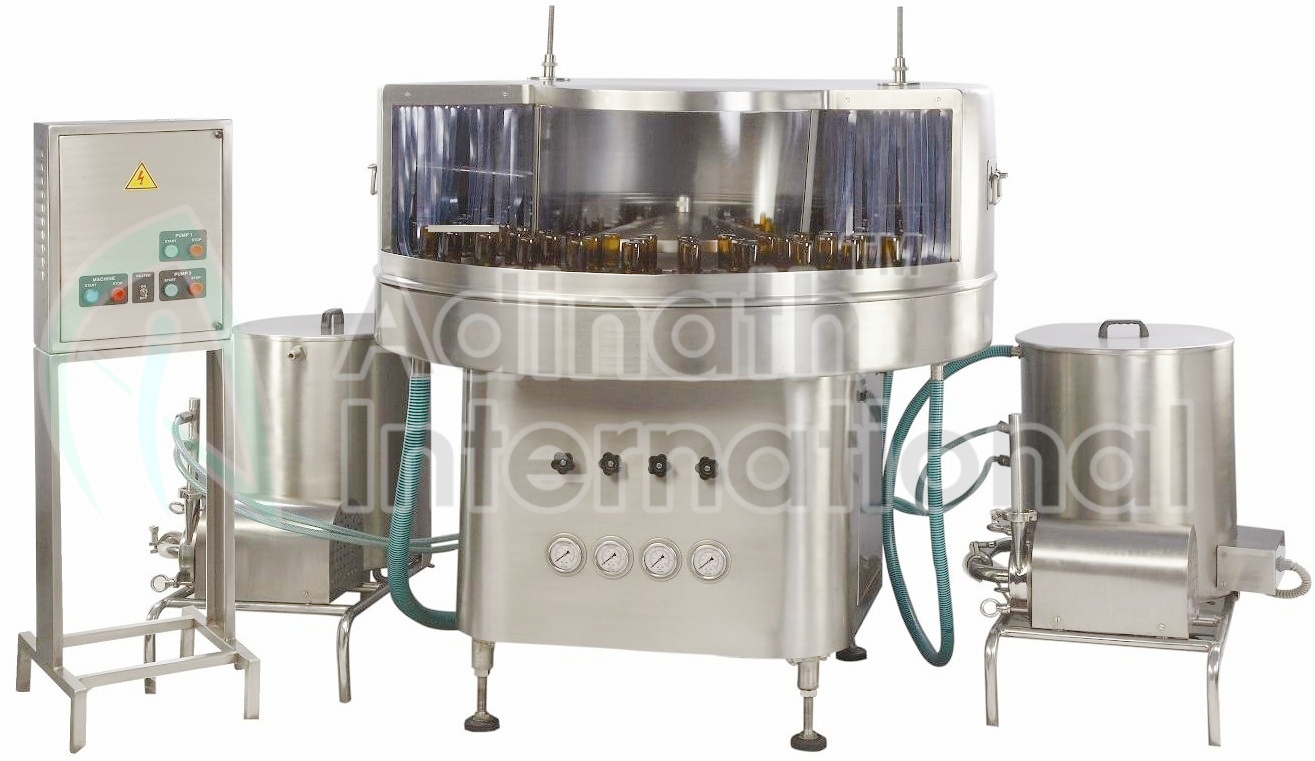
A Glass Bottle Washing Machine is an industrial or semi-automatic device designed primarily for cleaning and sanitizing reusable or returnable glass bottles used in beverage production (such as soft drinks, beer, wine, or dairy products), food processing, pharmaceuticals, cosmetics, and laboratories. Glass Bottle Washing Machine ensure hygienic conditions by removing residues, labels, dirt, and contaminants through a multi-stage process, while optimizing water, energy, and chemical usage to meet high-volume production demands.
Glass Bottle Washing Machine Video
Key Features and Components
Glass bottle washers typically feature a robust stainless steel construction for durability and corrosion resistance. Common elements include:
-
Compact and Versatile Design: Many models have a small footprint to fit limited spaces, with modular configurations (single-end or double-end) adaptable to various bottle shapes and sizes.
-
Automated Controls: Automatic temperature, caustic concentration, and speed regulation; self-cleaning filters; and IP55-protected electrical systems for low maintenance and ease of use.
-
High-Capacity Handling: Bottles are loaded into acid/alkali-resistant plastic pockets or crates and transported via conveyor systems.
-
Energy Efficiency: Reduced consumption of water, electricity, and detergents through recycled rinsing and optimized cycles, often achieving near-zero mechanical maintenance in advanced models.
Typical Washing Cycle
The process is compartmentalized into sequential stages for thorough cleaning without damaging the glass:
-
Pre-Washing (1-3 Stages): Initial jetting or immersion in warm water to remove loose debris and external dirt.
-
Soaking Bath: Bottles are submerged in a caustic (alkaline) solution with optional triple immersion cycles to loosen labels (paper or aluminum) and dissolve stubborn residues.
-
Detergent Jetting: High-pressure sprays with cleaning agents to scrub interiors and exteriors.
-
Rinsing (Multiple Stages): Recycled water for initial rinses, followed by fresh water for final hygienic rinse; self-centering rotating sprays ensure complete caustic removal.
-
Drying (Optional Integration): Air blowers or high-speed drying modules to prepare bottles for refilling.
This cycle typically takes 5-10 minutes per batch, depending on soil level and machine speed, and can be customized for new or heavily soiled returnable bottles.
Benefits and Applications
-
Hygiene and Safety: Guarantees product safety by eliminating contaminants, crucial for food-grade standards.
-
Cost Savings: Lowers operational costs by minimizing water (up to 50% recycled) and labor; ideal for high-throughput lines.
-
Versatility: Suited for wineries, breweries, dairy farms, and labs handling delicate glassware like wine bottles or lab vials.
Salient Features of Bottle Washing Machine
-
Geneva mechanism.
-
Four inner, one outer and one air wash.
-
Sequence of washes of washes to customer’s choice
-
Stationary nozzles eliminate contamination of water cycles.
-
Easy loading and unloading with two rows.
-
Individual solenoid valve for each washing sequence.
-
Pumps and tanks are mounted on parable stand for easy maintenance.
-
Easy operation.
-
Higher capacity centrifugal pumps to wash bigger bottles.
-
The stationary nozzles avoid chipping of bottle necks.
-
Bottle guide system especially for lightweight bottle.
-
Pumps and Tanks are mounted on portable stand for easy maintenance.
-
Separate panel control to avoid any short circuit due to spraying of water.
-
S.S. glycerin fill pressure meter.
Process Operation of Automatic Bottle Washer
The bottles are loaded on the subsequent indexing part of rotating platform and are cleared in series of operations. Specially designed bottle holders are provided to hold bottles with neck diameter. The bottles are placed in an inverted position in these cup shaped holders. Spraying showers does the external cleaning of the bottles. Solenoid valves are provided to enable the regulation of wash timings, it also spraying water when bottle are stopped means ensure saving of water and sequence of various washing media to suit specific requirement.
Technical Specification of Glass Bottle Washing Machine
|
Model No |
ARBW – 64 | ARBW – 100 |
| Production Output | Up to 60 Bottles / Minute (Depending on Bottle Size) |
Up to 100 Bottles / Minute (Depending on Bottle Size) |
|
Input Specification |
Diameter of the container: 25 mm to 100mm Outside Diameter of Neck: 20 mm to 38 mm (with the help of change parts) Height of the container: Up to 280 mm (with the help of change parts) |
Diameter of the container: 25 mm to 100mm Outside Diameter of Neck: 20 mm to 38 mm (with the help of change parts) Height of the container: Up to 280 mm (with the help of change parts) |
| Power Supply | Main Unit: 0.75 H.P., 380 Volt, 3 Phase, 4 Wire System, 50 Hz
Optional Accessories (2 Pumps – Pumping Station) 0.75 H.P., 380 Volt, 3 Phase, 4 Wires System, 50 Hz Electric Heater Tank: 2 K.W. |
Main Unit: 0.75 H.P., 380 Volt, 3 Phase, 4 Wire System, 50 Hz Optional Accessories (2 Pumps – Pumping Station) 0.75 H.P., 380 Volt, 3 Phase, 4 Wires System, 50 Hz Electric Heater Tank: 2 K.W. |
|
Overall Dimension |
1550 mm (L) x 1700 mm (W) x 1300 mm (H) approx. | 1800 mm (L) x 1700 mm (W) x 1300 mm (H) approx. |
| Air Consumption | 30 CFM @ 5 bar |
30 CFM @ 5 bar |
|
Net Weight |
650 kgs. approx. |
750 kgs. approx. |
* Power voltage can be adjusted as per customer’s domestic power voltage requirements.
* Rights of technical improvements & modification reserved.
* Illustrations & dimensions are shown for information purpose only.
Send Inquiry