
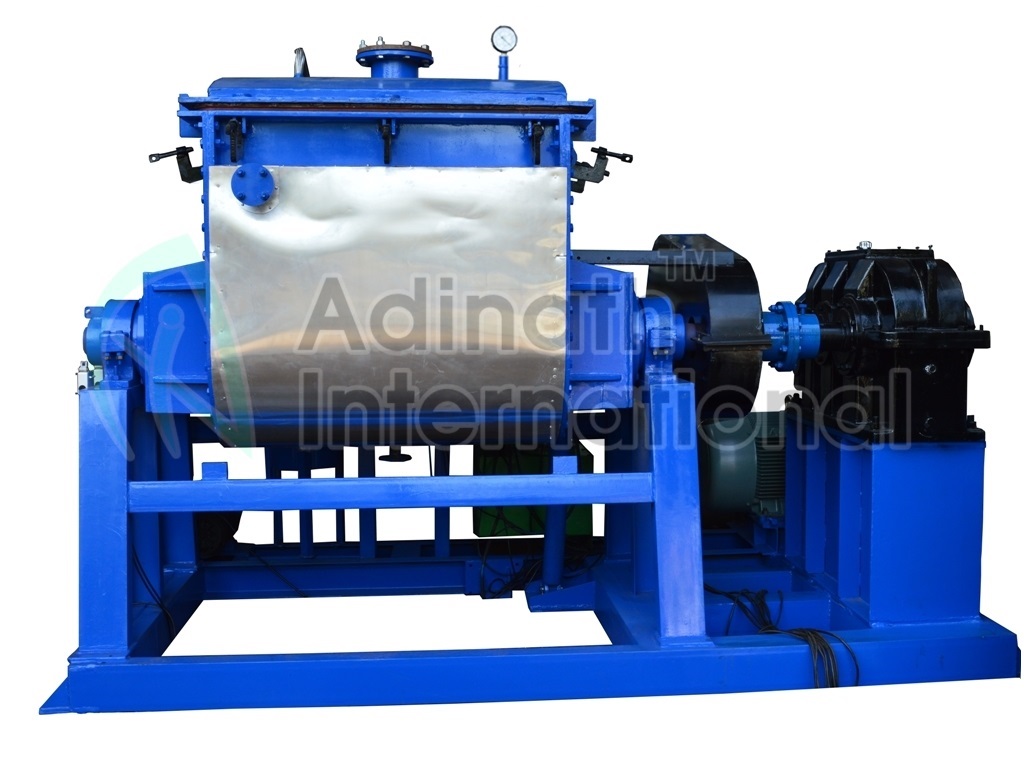
A Butyl Rubber Sigma Mixer (also called Z-blade mixer or double-arm kneader mixer) is a heavy-duty batch mixer specifically designed for high-viscosity, sticky, and rubber-like materials. When processing butyl rubber (IIR – polyisobutylene-isoprene rubber), which is extremely tacky, non-Newtonian, and has viscosities often exceeding 1–10 million cP, a sigma mixer is one of the most commonly used and effective machines in the industry.
Butyl Rubber Sigma Mixer Video
Why Sigma Mixers are Preferred for Butyl Rubber
-
Very high Mooney viscosity: Tangential sigma blades deliver the highest shear and kneading force among batch mixers
-
Needs mastication & breakdown: Differential blade speed + narrow blade-to-wall clearance break down polymer effectively
-
Incorporation of high filler loadings: Folding + stretching action distributes and disperses fillers without agglomeration
-
Oil extension: Slow-speed addition under vacuum prevents air entrapment and ensures uniform absorption
-
Curatives & accelerators: Excellent temperature control (±1 °C) via jacket + vacuum prevents premature scorching
-
No contamination: Stainless or carbon steel trough with hard-chrome or tungsten carbide coatings available
Special Features Recommended for Butyl/Halobutyl
-
Vacuum system with liquid-ring pump + dust filter (prevents black loss)
-
Extrusion discharge screw (bottom valve) → gives sheet or strip directly to two-roll mill
-
Tungsten carbide or Stellite blade edges & trough wear plates (black is abrasive)
-
Temperature control unit (TCU) with steam/hot oil + chilled water switching
-
PLC + recipe management (critical for reproducible scorch safety)
-
Explosion-proof design if solvents or zinc oxide dusting is involved
Salient Features of Sigma Mixer Machine
-
Available in Stainless Steel 316, Stainless Steel 304 and Mild Steel materials.
-
Stainless Steel polish to matt & mirror finish as per customer’s requirements.
-
Mild Steel finish with one coat of red oxide and two coats of epoxy paint.
-
Discharge option of hand wheel operated (manual) or hydraulic operated (automatic) offered.
-
Jacket for heating or cooling application can be offered.
-
Mineral wool insulation with cladding on jacket.
-
Tangential designed ‘Z’ blades offered for uniform mixing.
-
PTFE made shaft sealing provided for food grade compatibility.
-
Minimum gap between trough inner shell & blades removes possibility of sticking product.
-
On demand Spray system, vacuum system
Optional Features/Accessories of Sigma Mixer
-
Liquid Spray System
-
Vacuum System
-
Blades Cooling Arrangement
-
Screw System
-
Automatic Valve Discharge System
Process Operation of Butyl Rubber Sigma Mixer
In Sigma mixer tangential action of mixing and kneading obtained by ‘Z’ type (SIGMA) shaped kneading blades, which rotates very accurately at different speed towards each other causing product to be transferred from one end to another end. Discharge of the finished product is achieved by tilting the container or through the valves at the bottom or by means of an extrusion screw beside the container.
The mixing action is a combination of bulk movement, stretching, folding, dividing, and recombining of the material. The shearing & tearing action of the material against blades and the side walls causes size reduction of the solids. After the time period required for sterilizing the batch has elapsed, the heating circuit shuts of the pneumatics damper (exhaust) opens and cooling operation commences.
In the tangential design, the blades rotate in the trough meeting tangentially. The front blade generally rotates faster than the rear blade usually in the ratio of 3:2. Tangential blades are generally used for material of higher viscosities such as adhesives, rubber compounds, flush colors, dyes, and pigments.
In the overlapping design, the blades overlap above the saddle of the container. Due to the overlapping action, it is necessary that the relative position of the two blades is unchanged, and as a result, both the blades rotate at the same speed. Materials that flow freely or creep down into the blades are mixed using the overlapping blade action. This design offers a faster interchange of material from one blade compartment of the mixer to the other. Overlapping blade action is used for materials of lighter viscosities such as carbon pastes, clay coating, creams, and ointments. The overlapping blade produces a lower kneading and shearing compared to the tangential blade action.
Technical Specification of Sigma Mixer Kneader
| Model | Capacity – Liters | Motor (H.P.) | ||
| Working Capacity approx. | Gross Capacity approx. | General | Heavy Duty | |
| ASM – 50 | 50 Liters | 80 Liters | 5 H.P. | 7.5 H.P. |
| ASM – 75 | 75 Liters | 110 Liters | 7.5 H.P. | 10 H.P. |
| ASM – 100 | 100 Liters | 150 Liters | 10 H.P. | 15 H.P. |
| ASM – 150 | 150 Liters | 200 Liters | 15 H.P. | 20 H.P. |
| ASM – 200 | 200 Liters | 300 Liters | 20 H.P. | 25 H.P. |
| ASM – 400 | 400 Liters | 550 Liters | 30 H.P. | 40 H.P. |
| ASM – 500 | 500 Liters | 750 Liters | 40 H.P. | 50 H.P. |
| ASM – 750 | 750 Liters | 1150 Liters | 50 H.P. | 60 H.P. |
| ASM – 1000 | 1000 Liters | 1500 Liters | 60 H.P. | 70 H.P. |
| ASM – 1500 | 1500 Liters | 2100 Liters | 75 H.P. | 80 H.P. |
| ASM – 2000 | 2000 Liters | 2600 Liters | 80 H.P. | 90 H.P. |
| ASM – 3000 | 3000 Liters | 3800 Liters | 100 H.P. | 120 H.P. |
* Power voltage can be adjusted as per customer’s domestic power voltage requirements.
* Rights of technical improvements & modification reserved.
* Illustrations & dimensions are shown for information purpose only.
Send Inquiry